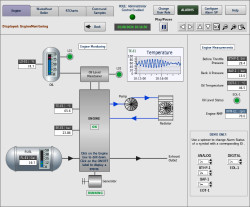
The Web Edition of the GLG Toolkit makes it possible to create
dynamic graphical pages for visualizing real-time processes in
a Graphical Editor and deploy them on the Web using
JavaScript in either plain HTML
or in the React,
Angular or
Next.js
framework.
With the Toolkit, dynamic HMI screens are created in an
interactive Graphics Builder and deployed on the web
using the GLG JavaScript library, which provides the
same high update rate and elaborate user interaction as a
conventional desktop application.
The GLG Graphics Server for either ASP.NET or JSP is also
available for an alternative server-side web
deployment of legacy applications that can reuse
existing C# or Java application code. With the Graphics Server,
the graphics is generated on the web server and displayed in a
browser as an image that is periodically updated.
For conventional desktop applications, both the
C/C++, C# and Java editions
of the Toolkit are also available.
Point and Click HMI Editor
The Web Edition of the GLG Toolkit includes the
GLG Graphics Builder
- a graphical editor with point and click interface for creating
dynamic HMI and SCADA screens and diagrams. With the
Graphics Builder, developers can create elaborate
process control and system monitoring drawings, define
dynamic behavior and attach real-time data sources.
A number of pre-built
components
and palettes are available
for use as building blocks in the Builder. An optional
GIS Map component is also available.
The HMI screens use vector graphics and are
resolution-independent,
which makes it possible to deploy them on a wide range
of displays - from large monitors to mobile devices.
Drawings created with the Builder can be reused between all
deployment platforms - C/C++, C#, Java, JavaScript / React /
Angular / Next.js, for both desktop, Web and Mobile deployment.
Web / Mobile Deployment with JavaScript / React / Angular /
Next.js
The GLG JavaScript Library is used to
deploy the HMI displays on a web page in a browser,
on any desktop or mobile device. The library provides an API to
load and display drawings created with the Graphics Builder,
animate them with real-time data and handle user
interaction.
The GLG JavaScript Library implements full GLG run-time
functionality present in the GLG C/C++, C# and Java
libraries, allowing the same graphical page and
programming logic to be shared between the desktop, web
and mobile versions of an application.
The React, Angular and Next.js GLG
components are provided in
the React,
Angular and Next.js integration examples and may be used to
integrate GLG drawings in the React, Angular and Next.js
frameworks. The GLG-related part of the JavaScript source code
may be shared between the React, Angular, Next.js and standalone
HTML versions of an application, as shown in
the GLG demos and examples.
The library uses HTML5 canvas to render
graphics and supports all major browsers:
Chrome, Firefox, Edge and Safari, as well as mobile
browsers. Since all rendering is performed by the
browser on the client side, the server load is reduced,
making it possible to use low-end embedded web servers
for hosting a web application.
Web / Mobile Deployment with AJAX and
Server-Side Graphics Server
The
GLG Graphics Server
may be used as an alternative way to
web-deploy legacy applications
written in Java or C# on an application server.
The Graphics Server takes care of generating dynamic images of
the HMI displays and updating them with the real-time data. The
Graphics Server uses the same C# or Java API as the
corresponding desktop applications, making it possible to reuse
the existing application code and quickly deploy the application
on the web with ASP.NET or JSP with minimal
changes.
More Information
HMI Configurator for OEM Use
The GLG HMI
Configurator, a
simplified version of the HMI editor for the end-users,
is also available. It may be used for OEM distribution by
system integrators and can be extensively customized
with custom actions, icons, dialogs, data browser and
other custom features.
The HMI Configurator may also be used for developing
cloud-based SCADA and monitoring systems,
where a customer creates a drawing, specifies real-time data
sources and uploads the drawing to a server for a web or mobile
deployment.
|